
In the 19th century, New York was considered to be the largest and most influential city in the USA. During the Civil War from 1861 to 1865, it had a great influence on the military operations and the coverage of the war in the American mass media. In particular, this city was the main source of troops, ammunition, equipment and funding for the Union Army. As a result, the large military aid and New Yorkers’ struggle for independence changed US history and politics. Find out more about this at new-york-yes.
Causes of the Civil War in the USA
The American Civil War, which is also called the war between the North and the South, went down in history as the largest military conflict on the American continent. In the early 1860s, many contradictions arose between these 2 regions, leading to battles and political division in the country.
According to historians, in the 19th century, ambitious natives from middle and lower class families lived in the North of the United States. There were many emigrants who came to America in search of a better life. They developed industry and infrastructure. Everyone who sought to create a strong and independent capitalist state was guaranteed freedom of action and many opportunities.
The wealthy descendants of the European aristocracy, the planters, lived in the South. They owned agricultural areas and used slaves to cultivate the lands. Thus, these 2 regions were independent, but at the same time different and had their own politics. Because of this, conflicts often arose between them, which became a consequence of the beginning of the Civil War in the USA, namely:
1. Political contradictions. The population of the North was replenished by free emigrants, and the South by slaves from abroad. Because of this, in the early 1860s, only a quarter of the population of the South had the right to vote. Southerners bewared that in this regard important political decisions in Congress would be made in favor of the North. In addition to that, the American government in the North sought to influence all states. Meanwhile, representatives of the South wanted to preserve local self-government.
2. Economic contradictions. The North of America was the center of industrial development. The South was the main supplier of plant raw materials. For a long time, the Southern states supplied agricultural crops to the North. There, they were processed in factories and sent for export to other countries. However, plantation owners later realized that it was more profitable to trade with Europe without intermediaries. Wanting to maintain a high level of trade and profit in the country, the American government imposed huge taxes on trade with Europe and thereby caused discontent among the residents of the southern states.
3. Social contradictions. In the 19th century, agricultural efficiency in the South was supported by slave labor. The activities of unskilled workers in the North were considered to be of poor quality and therefore unprofitable. The industrialists of the northern states advocated the abolition of slavery. For plantation owners in the South, this meant the collapse of an economic system that was based on free labor. In addition to that, many American public figures negatively criticized slavery, calling it an inhuman relic of the past and demanded its abolition.
Due to these contradictions, many problems and difficulties arose among the residents of the 2 regions of the USA. The last event that forever destroyed their beneficial trade and economic relations was the coming to power of president Abraham Lincoln in 1860. He ran for the Republican Party. Its representatives, like Lincoln himself, advocated the abolition of slavery and the development of trade turnover within the country. This was the beginning of a large-scale confrontation between the inhabitants of the North and the South.
On December 20, 1860, South Carolina announced its withdrawal from the United States. A few months later, states like Florida, Arizona, Texas, Tennessee and others joined it. Separating from the North, they organized a new state — the Confederate States of America. They also adopted a new constitution and elected the American military and politician Jefferson Phineas Davis as president. Thus, representatives of the North and the South became opponents in the subsequent Civil War.
Preparation of New York for the Civil War
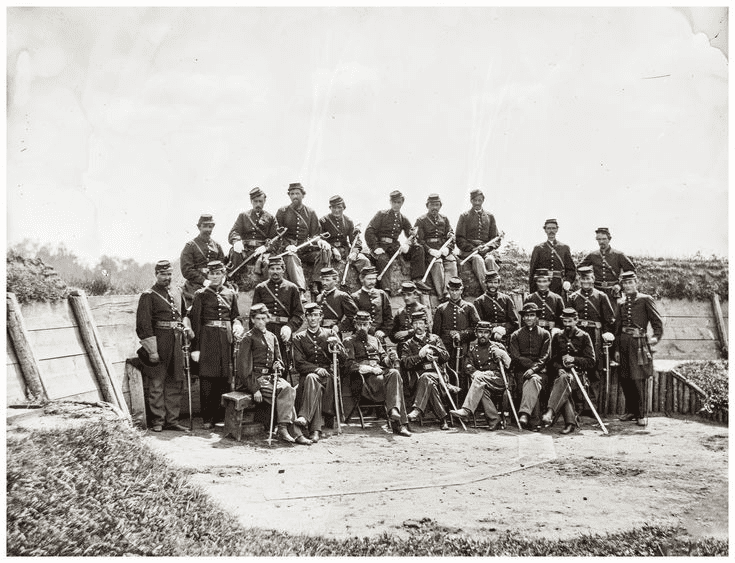
New York, as the largest city in the USA at that time, became the center of preparation for a large-scale confrontation between the armies of the North and the South. Before the start of the Civil War, several forts were built here to further accommodate the garrison of the Northern troops and protect New York harbor from a possible attack by the enemy army — the Confederate States of America.
New Yorkers also created and expanded several military hospitals to serve the large number of wounded and sick. Rikers Island was decided to be used as a military training ground for US troops. All new soldiers underwent professional training at Camp Astor. No less important was to do the construction and repairing of ships. The Brooklyn Navy Yard, founded in 1801 in the Brooklyn area, was chosen for this purpose.
After preparations for the start of the Civil War had been over, President Abraham Lincoln issued a call for volunteers to serve in the Union Army. Residents of New York began to join the army and collect financial aid for the military. At the beginning of 1861, in 3 months, New Yorkers collected 150 million dollars for military needs. By the end of May, there were 30,000 people in the volunteer army. Lincoln’s friend, officer Elmer Ellsworth, became their military commander.
The troops marched down Broadway and went to war to loud cheers and shouts. In general, New York sent more than 400,000 soldiers to the battlefield. Apart from them, about 50,000 sailors joined the naval forces of the Army of the North.
Participation of New Yorkers in battles
New York troops played an important role in the confrontation against the army of the Confederate States of America. In many battles, the Army of the North gained victory. For instance, the Battle of Franklin in Tennessee state ended in success for the soldiers and the New York military commander John Scofield. After that the adversary suffered heavy losses and was forced to retreat.
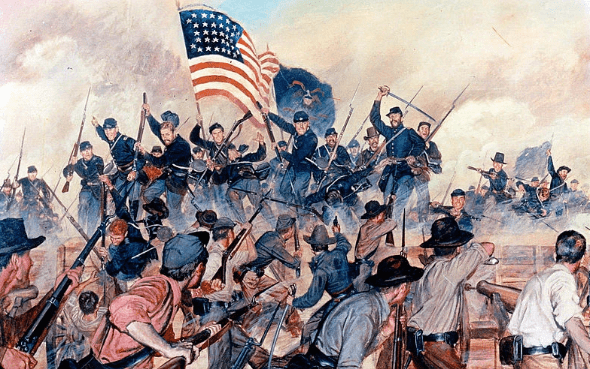
The bloodiest battle was the three-day Battle of Gettysburg in 1863. Consequently, about 1,000 people were killed and 4,000 wounded. On the first day of the battle, 2 large Confederate units attacked the New Yorkers from the northwest, forcing them to retreat south. The next day, fierce battles took place on the hills of Pennsylvania state and then intensified at Culp’s Hill and Cemetery Hill. Despite this, the Union Army held its positions. On the third day, the shooting occurred. The New Yorkers destroyed the army of the Confederate States of America with artillery fire. After that they gained another victory in the battle.
The final defeat of the soldiers from the South was on the Atlantic coast in 1865, when they were deprived of equipment and could not advance due to capture by the northerners. At that time, they suffered because of the prolonged bombardment and the lack of replenishment of the army with new soldiers.
Consequences of the Civil War
The Civil War entered the history of the United States as the most destructive and bloody one. The losses of the soldiers of the Army of the North amounted to almost 360,000. The Confederates lost about 258,000. The military expenses of the US government exceeded about 3 billion dollars. Despite this, the Civil War demonstrated the new capabilities of artillery and became an incentive for the further development of the military industry.
In New York and other large cities, military build-up and strengthening of the civil defense system began. Also, in the USA, slavery and the separation of the white population from other ethnic groups, including blacks and Indians, were abolished.